Loading...
Searching...
No Matches
constitutive::Load< T > Struct Template Reference
#include <load.hpp>
Public Member Functions | |
| virtual | ~Load ()=default |
| destructor | |
| virtual void | initialize (StateVariable< T > &sv) |
| initialize the load | |
| void | clear () |
| clear the load phases | |
| LoadPhase< T > & | operator[] (const int &idx) |
| Access a load phase. | |
| LoadPhase< T > | operator[] (const int &idx) const |
| Access a load phase. | |
| LoadPhase< T > | at (const int &idx) const |
| Access a load phase. | |
| bool | empty () const |
| If the phases are empty. | |
| int | size () const |
| number of load phases | |
| const LoadPhase< T > & | back () const |
| last load phase | |
| void | emplace_back (const LoadPhase< T > &phase) |
| emplace back a load phase | |
| int | totalSteps () const |
| total number of steps | |
| LoadPhase< T > & | addLoadPhase (const LoadPhase< T > &phase) |
| add a load phase | |
| LoadPhase< T > & | addIsotropicPhase (const T sigc, const int steps) |
| add an isotropic load phase | |
| LoadPhase< T > & | addDrainedTriaxialPhase (const T sigc, const T eps1, const int steps, const int axis=1) |
| add a drained triaxial load phase | |
| LoadPhase< T > & | addConstantStressRatioPhase (const T sig3_min, const T sig3_max, const T eta, const int steps, const int axis=1) |
| add aconstant stress ratio load phase | |
| LoadPhase< T > & | addUndrainedTriaxialPhase (const T eps1, const int steps, const int axis=1, const bool no_epsv=false) |
| add an undrained triaxial load phase | |
| LoadPhase< T > & | addUndrainedTrueTriaxialPhase (const T eps1, const T b, const int steps, const int axis1=1, const int axis2=2, const bool no_epsv=true) |
| add an undrained true triaxial load phase | |
| LoadPhase< T > & | addUndrainedTrueTriaxialWithAxialStrainPhase (const T epsa, const T b, const int steps, const int axis1=1, const int axis2=2, const bool no_epsv=true) |
| add an undrained true triaxial load phase with axial strain control | |
| LoadPhase< T > & | addUndrainedTriaxialWithoutShearPhase (const T eps1, const int steps, const int axis=1, const bool no_epsv=false) |
| add an undrained triaxial load phase with controlling the shear strain | |
| LoadPhase< T > & | addTrueTriaxialWithConstantShearPhase (const T p, const T b, const int steps, const int axis1=1, const int axis2=2) |
| add a true triaxial load phase with constant shear | |
| LoadPhase< T > & | addTrueTriaxialPhase (const T sig3, const T b, const T eps1, const int steps, const int axis1=1, const int axis2=2) |
| add a true triaxial load phase | |
| LoadPhase< T > & | addConfinementPhase (const T eps1, const int steps) |
| add a confinement load phase | |
Static Public Member Functions | |
| static Eigen::Matrix< int, 6, 1 > | axisIndex (const int axis=1) |
| index of the loading axis | |
Public Attributes | |
| std::vector< LoadPhase< T > > | phases = {} |
| load phases | |
Detailed Description
template<typename T>
struct constitutive::Load< T >
struct constitutive::Load< T >
Load.
Constructor & Destructor Documentation
◆ ~Load()
template<typename T>
|
virtualdefault |
destructor
Member Function Documentation
◆ addConfinementPhase()
template<typename T>
|
inline |
add a confinement load phase
- Parameters
-
eps1 maximum strain steps number of steps
- Returns
- added load phase
References addLoadPhase().
Here is the call graph for this function:

◆ addConstantStressRatioPhase()
template<typename T>
|
inline |
add aconstant stress ratio load phase
- Parameters
-
sig3_min minimum value of minimum principal stress sig3_max maximum value of minimum principal stress eta constant stress ratio steps number of steps axis loading axis, 1, 2, 3
- Returns
- added load phase
References addLoadPhase(), and axisIndex().
Here is the call graph for this function:

◆ addDrainedTriaxialPhase()
template<typename T>
|
inline |
add a drained triaxial load phase
- Parameters
-
sigc confined stress eps1 maximum strain steps number of steps axis loading axis, 1, 2, 3
- Returns
- added load phase
References addLoadPhase(), and axisIndex().
Referenced by addTrueTriaxialPhase().
Here is the call graph for this function:

Here is the caller graph for this function:

◆ addIsotropicPhase()
template<typename T>
|
inline |
add an isotropic load phase
- Parameters
-
sigc confined stress steps number of steps
- Returns
- added load phase
References addLoadPhase().
Here is the call graph for this function:

◆ addLoadPhase()
template<typename T>
|
inline |
add a load phase
- Parameters
-
phase load phase
- Returns
- added load phase
References empty(), and constitutive::LoadPhase< T >::isCompatibleWith().
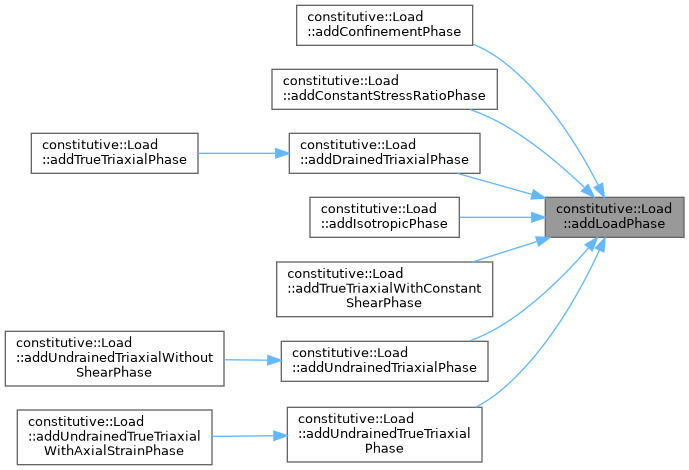
Referenced by addConfinementPhase(), addConstantStressRatioPhase(), addDrainedTriaxialPhase(), addIsotropicPhase(), addTrueTriaxialWithConstantShearPhase(), addUndrainedTriaxialPhase(), and addUndrainedTrueTriaxialPhase().
Here is the call graph for this function:

Here is the caller graph for this function:
◆ addTrueTriaxialPhase()
template<typename T>
|
inline |
add a true triaxial load phase
- Parameters
-
sig3 minimum principal stress b intermediate stress ratio eps1 maximum strain steps number of steps axis1 major axis, by default 1 axis2 intermediate axis, by default 2
- Returns
- added load phase
References addDrainedTriaxialPhase().
Here is the call graph for this function:

◆ addTrueTriaxialWithConstantShearPhase()
template<typename T>
|
inline |
add a true triaxial load phase with constant shear
- Parameters
-
p mean stress b intermediate stress ratio steps number of steps axis1 major axis, by default 1 axis2 intermediate axis, by default 2
- Returns
- added load phase
References addLoadPhase().
Here is the call graph for this function:

◆ addUndrainedTriaxialPhase()
template<typename T>
|
inline |
add an undrained triaxial load phase
- Parameters
-
eps1 maximum strain steps number of steps axis loading axis, 1, 2, 3 no_epsv whether to control the intermediate principal stress without generating volumetric strain, this is useful when the material fabric is non-coaxial with the principal stress, by default false
- Returns
- added load phase
References addLoadPhase(), and axisIndex().
Referenced by addUndrainedTriaxialWithoutShearPhase().
Here is the call graph for this function:

Here is the caller graph for this function:

◆ addUndrainedTriaxialWithoutShearPhase()
template<typename T>
|
inline |
add an undrained triaxial load phase with controlling the shear strain
- Parameters
-
eps1 maximum strain steps number of steps axis loading axis, 1, 2, 3 no_epsv whether to control the intermediate principal stress without generating volumetric strain, this is useful when the material fabric is non-coaxial with the principal stress, by default false
- Returns
- added load phase
References addUndrainedTriaxialPhase().
Here is the call graph for this function:

◆ addUndrainedTrueTriaxialPhase()
template<typename T>
|
inline |
add an undrained true triaxial load phase
- Parameters
-
eps1 maximum strain b intermediate stress ratio steps number of steps axis1 major axis, by default 1 axis2 intermediate axis, by default 2 no_epsv whether to control the intermediate principal stress without generating volumetric strain, this is useful when the material fabric is non-coaxial with the principal stress, by default true
- Returns
- added load phase
References addLoadPhase().
Referenced by addUndrainedTrueTriaxialWithAxialStrainPhase().
Here is the call graph for this function:

Here is the caller graph for this function:

◆ addUndrainedTrueTriaxialWithAxialStrainPhase()
template<typename T>
|
inline |
add an undrained true triaxial load phase with axial strain control
- Parameters
-
epsa axial strain b intermediate stress ratio steps number of steps axis1 major axis, by default 1 axis2 intermediate axis, by default 2 no_epsv whether to control the intermediate principal stress without generating volumetric strain, this is useful when the material fabric is non-coaxial with the principal stress, by default true
- Returns
- added load phase
References addUndrainedTrueTriaxialPhase(), and constitutive::vec2mat().
Here is the call graph for this function:

◆ at()
template<typename T>
|
inline |
Access a load phase.
- Parameters
-
idx index of the load phase
- Returns
- load phase
◆ axisIndex()
template<typename T>
|
inlinestatic |
index of the loading axis
- Parameters
-
axis loading axis, 1, 2, 3
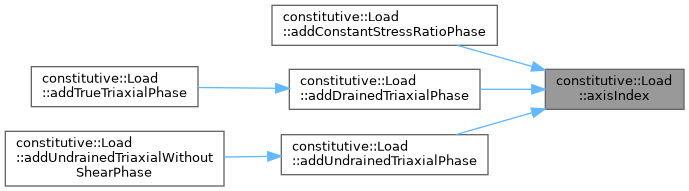
Referenced by addConstantStressRatioPhase(), addDrainedTriaxialPhase(), and addUndrainedTriaxialPhase().
Here is the caller graph for this function:
◆ back()
template<typename T>
|
inline |
last load phase
- Returns
- last load phase
◆ clear()
template<typename T>
|
inline |
clear the load phases
◆ emplace_back()
template<typename T>
|
inline |
emplace back a load phase
- Parameters
-
phase load phase
◆ empty()
template<typename T>
|
inline |
If the phases are empty.
- Returns
- true if empty, false otherwise
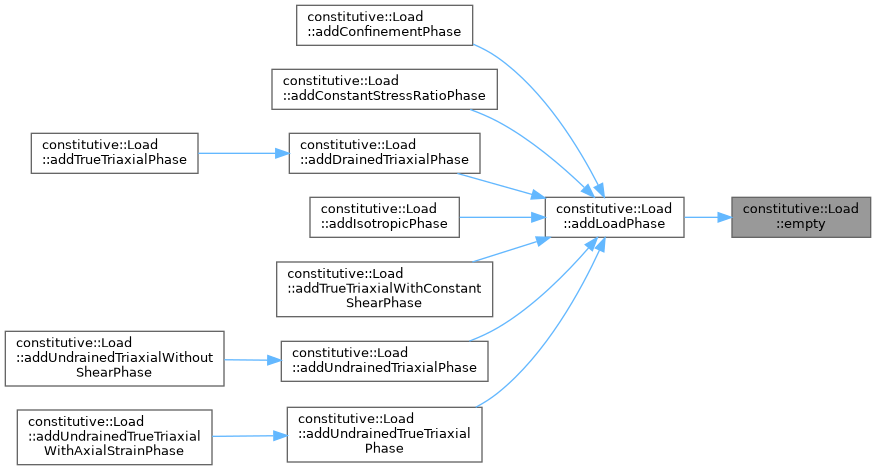
Referenced by addLoadPhase().
Here is the caller graph for this function:
◆ initialize()
template<typename T>
|
inlinevirtual |
initialize the load
◆ operator[]() [1/2]
template<typename T>
|
inline |
Access a load phase.
- Parameters
-
idx index of the load phase
- Returns
- load phase
◆ operator[]() [2/2]
template<typename T>
|
inline |
Access a load phase.
- Parameters
-
idx index of the load phase
- Returns
- load phase
◆ size()
template<typename T>
|
inline |
number of load phases
- Returns
- number of load phases
◆ totalSteps()
template<typename T>
|
inline |
total number of steps
- Returns
- total number of steps
Member Data Documentation
◆ phases
template<typename T>
| std::vector<LoadPhase<T> > constitutive::Load< T >::phases = {} |
load phases
The documentation for this struct was generated from the following file:
- include/constitutive/load.hpp